|
TERMS OF USE:
This free image can only be used for non-commercial, personal
website use only. THIS IMAGE CANNOT BE
used in galleries, downloaded to your computer, posted on sites for
others to use, manipulated, downsized, or upsized. If you are confused about the
terms of use or have any questions then contact us before using the image.
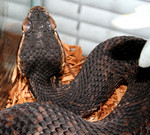
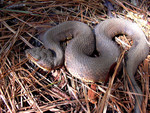
Free Picture: Western Cottonmouth Snake (Agkistrodon Piscivorus Leucostoma)
|
Description
This picture depicts a dorsal oblique view of a “western cottonmouth” snake Agkistrodon piscivorus leucostoma. The cottonmouth snakes display a distinct two-tone coloration, the spade-like shaped head, a lateral positioning of the eyes, vertically elliptical pupils, cheek stripes, and loreal pits. All of the American copperheads, cottonmouths and rattlesnakes are members of the family “viperidae”. The western cottonmouth is the smallest, but most widely distributed cottonmouth subspecie. The dorsal body is patterned with 10 to 15 dark cross-bands similar to the other two subspecies, but often tends to darken at an early age. The top and sides of the snout are usually uniformly dark brown to black with no visible pattern except in juveniles. When visible, the upper side of the dark cheek stripe often lacks the contrasting light borders that are characteristic of the Florida and eastern subspecies (Gloyd and Connant, 1990).
The western cottonmouth inhabits a large area within the southeastern to central United States, extending from Alabama and western Georgia, west throughout Arkansas, and southern Missouri, southward through eastern and central Oklahoma and Texas, down to the level of Corpus Christi (Gloyd and Connant 1990; Price, 1996). In the western and northern fringes of its range, this snake tends to exist in isolated pockets that are distributed along arborizing river systems. The ground color and natural history of this subspecies varies considerably over its extensive range, and is different enough from its eastern cousins, to possibly warrant consideration of it as a separate species.
The A. piscivorus leucostoma habitat includes hurricane-prone regions of the United States, which is of importance to those who either live in these regions, or who might be deployed to such areas as a first-responder offering aid to those affected by such a disaster.
This image was created in 2005 and was provided by the Centers for Disease Control and Prevention/Edward J. Wozniak D.V.M., Ph.D., Michael Smith.
Keywords
agkistrodon piscivorus, animal, animals, cottonmouth, cottonmouths, pit viper species, reptile, reptiles, serpent, serpentes, snake, snakes, water moccasin, water moccasins, western cottonmouths, cdc, western cottonmouth, free photography, free photo, free photos, free picture, free pictures, free image, free images
|
Similar Free snake Pictures
|
|
|
|